
An engineering classroom
learned in English
From age six to the end of elementary school, a curriculum built to grow an engineer's mind. From lessons where children make things with their own hands to lessons where they build in a programming language — and by explaining what they made to their friends, they learn English and how to think like an engineer.
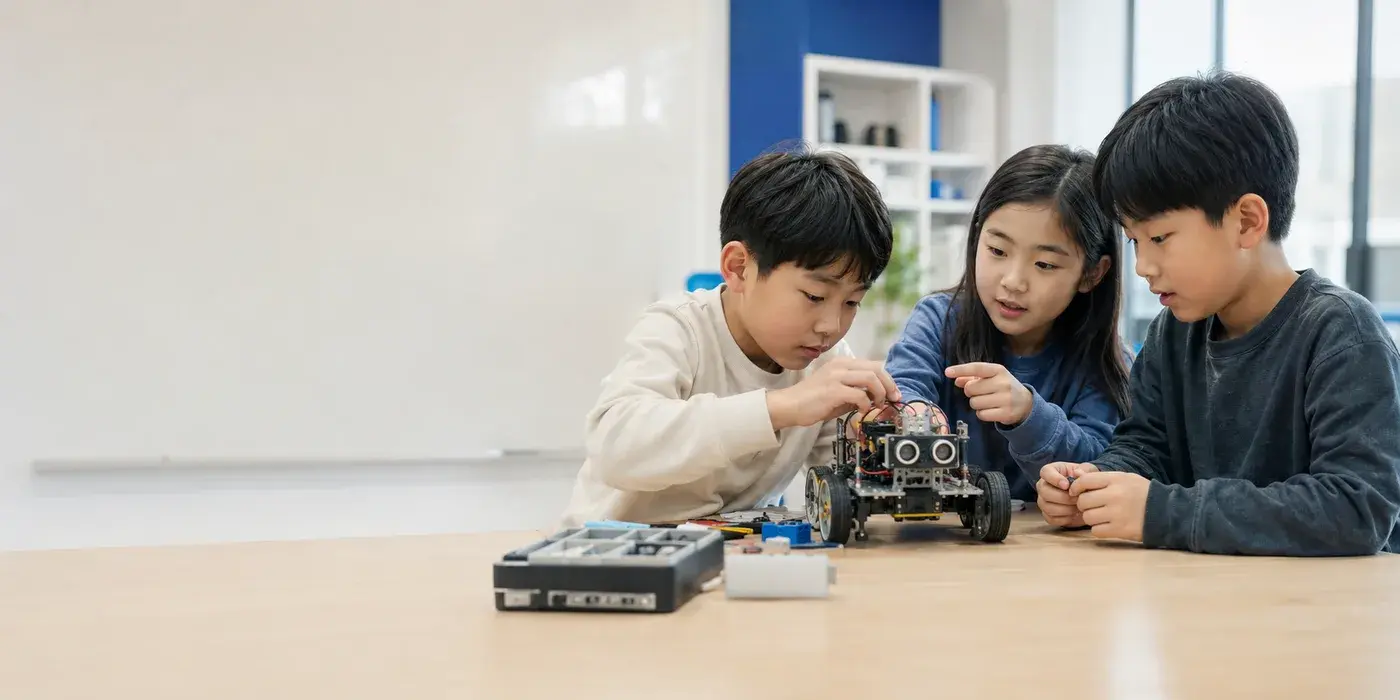
Courses
What's different
Children pick up English naturally
Lessons run entirely in English, and each day's task is tied to the words being learned that day. While a child is busy making something, the English comes along with it.
Eight years connected as one
The courses are not entirely separate from one another. The logical thinking a child practises through play at SEED starts being called coding at SPARK, becomes block programming at MAKER, and turns into Python at ENGINEER. Engineering thinking accumulates at every stage.
Predicting and testing becomes a habit
Whatever the task, children say and write down the result they expect first. When the actual result differs, they work out why and say so. The same habit runs from simple colour mixing to programming, training the way an engineer thinks.
Children learn how to present
Every six months we hold a Demo Day. Children show what they made themselves and explain, in English, what they built and what they changed.
What they make goes home
Every piece a child makes goes home with them, so that curiosity about engineering keeps going. The more they can hold and see, the more that curiosity grows.
Screens only when they are needed
Through the lower elementary years, learning is analogue — younger children learn better with their hands. Handling a device for programming starts at SPARK, and even then only in the lessons that need one.
Stage by stage
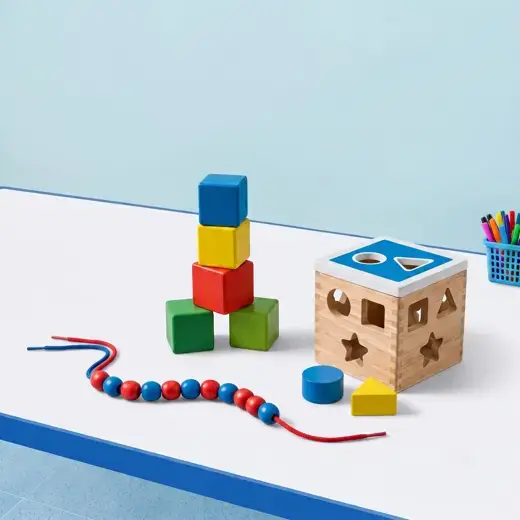
Ages 6–7 · 4 courses × 6 months · 2 × 60 min a week
Four courses, eight rungs of sentence. Describe it exactly and give an instruction. State a rule and compare two things. Count, show the evidence and say why. Plan it, say what you changed, then explain it to somebody who was not there.
The class runs on making and testing: mixing colours, talking a friend through an obstacle course, measuring shadows onto a chart, doing a recipe in the wrong order on purpose. She is not sitting through an English lesson. She is getting something done in English.
What a six-year-old needs is not more words. It is the experience of getting what she wants with the words she has.
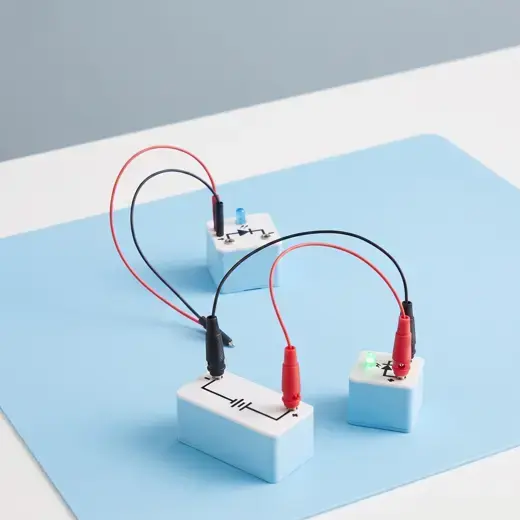
Grades 1–2 · 4 courses × 6 months · 1 × 90 min a week
Order, repetition, conditions: the ideas coding is built on, learned by hand. With batteries and switches, with robots, with levers, gears and motors, and with devices that combine them.
Children take home what they build: a metal-loop game, a lifting machine, a pop-up animal house, a biscuit-tin fortune teller, a guard box. What gets built depends on the course; these are a few examples.
This is where a device is first used for programming. Until then, coding is learned with the body, with paper, and with robots.
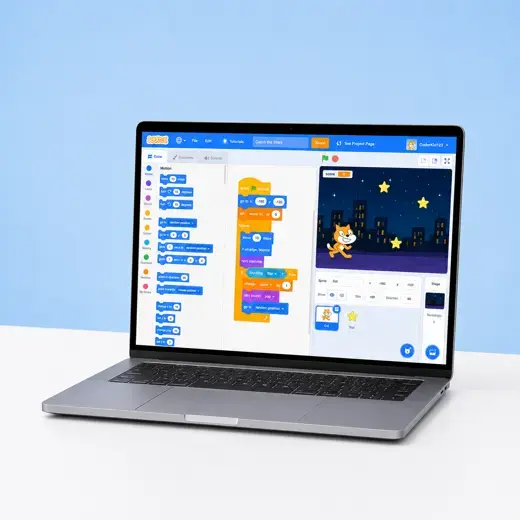
Grades 3–4 · 4 courses × 6 months · 1 × 120 min a week
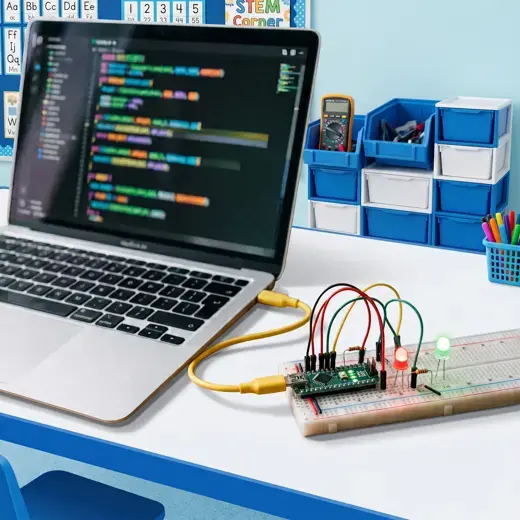
Programs written in blocks: order, conditions, variables and loops, then lists, text and speech. With a micro:bit connected, her program reads light, sound and tilt sensors and acts on the readings.
The things she builds add up. A few examples: an animation of a character she drew, a stage show, a story that changes with the viewer's choice, a controller she presses by hand, a meter that graphs the values it measures, a machine that asks your name and answers, a board that talks, and a game of her own. What gets built changes with the course; these are a few of them.
She reads a program somebody else wrote, finds where it goes wrong, changes one thing and runs it again. Reading and fixing errors is the lesson itself.
Children who only used what engineering produced now make their own. The result of this stage is work somebody else can sit down and try.
Grades 5–6 · 4 courses × 6 months · 1 × 120 min a week
Python. Children design and write code in a real programming language. The design and the discussion around it all happen in English, so this is the stage where a child reads and writes the most English.
Through this stage, worthwhile programs pile up one by one. A few examples: a data story built from numbers they collected themselves, a mood lamp that comes on when the room gets dark, a car that follows a line on the floor, a machine that understands a hand gesture, a model trained on their own data. What gets built changes with the course; these are a few of them.
From the third of the four courses, programs leave the laptop and connect to real hardware. The code a child wrote switches on the mood lamp and drives the car. In the last course they complete a piece of their own, with a guide and a history, so that somebody else could pick it up, read it and run it.
This is where a child makes something truly their own. What they take away is objects that actually work, and the programs running inside them.

Meet Adriana
She teaches every lesson herself, entirely in English. She is also fluent in Korean, so she can help in Korean when a child gets stuck.
- BA, Yonsei University
- MSc Artificial Intelligence, University College London
- Doctoral researcher, Brain and Cognitive Engineering lab, KAIST
Book a consultation
Leave your child's age and whatever you would like to know, and we will get back to you. Call or text — whichever is easier.
010-9545-9828Your request was received
We will be in touch within a day. If it is urgent, please call.